Getting Uncomfortable
Overview
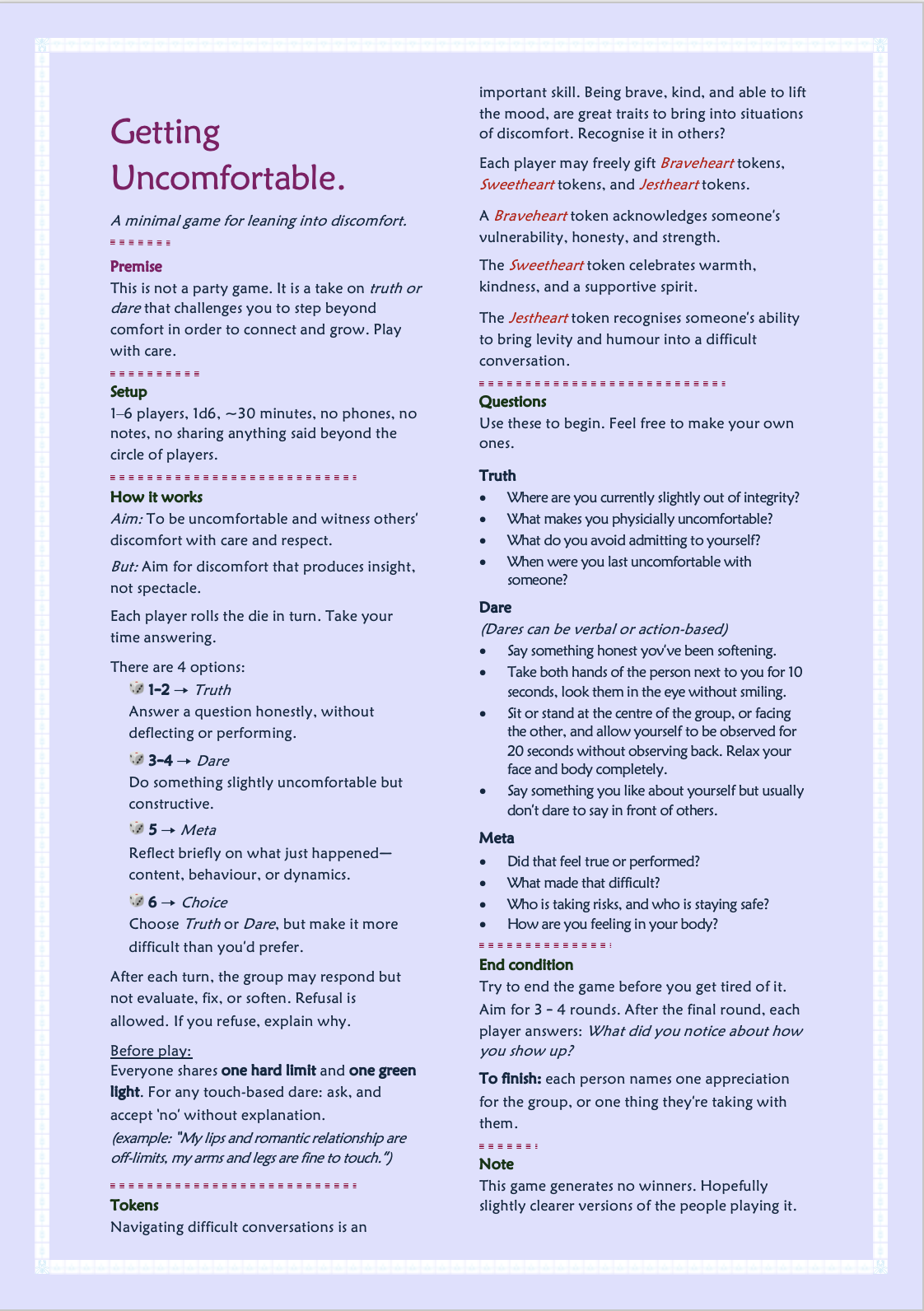
Getting Uncomfortable is a one-page RPG created for a university final assignment in storytelling for the digital humanities at the University of Alberta.
Using dice-based prompts, it invites players to engage with discomfort in playful but constructive ways through truths, dares, and meta-reflection.
Focus
This project explores how games can function as small ethical laboratories: spaces for experimentation, self-observation, and deliberate practice.
Context
The motivation for this project was the observation that in my perception of Western society (of which I am a part), discomfort is something many of us seem to avoid. While this is understandable—it is, after all, uncomfortable—I think we have much to learn by leaning into rather than away from it.
There are many different kinds of discomfort: physical, mental, emotional; productive versus alarming. Many athletes learn to befriend physical discomfort, and emotionally intelligent people can use discomfort as a gauge and indicator. I find emotional and social discomfort in particular to be difficult to engage with, and wanted to create a dedicated space in which it could be explored with others.
Being able to distinguish between different types of discomfort is vital for resilience, self-understanding, and social navigation. At the same time, it is difficult to simply ‘get into’ discomfort without some kind of structure that facilitates this. This game is designed to provide such a frame, and I think it can offer several benefits:
It de-stigmatises discomfort and reduces our aversion to it, making it easier to navigate in other contexts. The more we are exposed to and actively engage with discomfort, the easier it becomes to recognise and handle.
It familiarises players with different types of discomfort and sharpens their ability to distinguish between them. The better one understands their own discomfort and triggers, the more effectively it can be used as an indicator of what one likes or dislikes, wants or does not want.
It enables people to identify past discomforts, put them into words, and share them with others they trust. Being able to not only recognise but also articulate discomfort is an important interpersonal skill, especially in navigating conflict across different social contexts and relationships.
Discomfort can also point us towards injustice. Identifying discomfort in our own treatment, or in the treatment of others we witness, can serve as an important signal. By naming and addressing these moments, we can contribute to more inclusive, respectful, and caring social environments.
Discomfort, then, is not just something to “get over”, but a valuable resource that we can learn to engage with more directly. This is the premise from which the game was created.
The RPG is deliberately small and short, though not easy. I wanted to make the tools as simple as possible, as the experience itself can be challenging. The colours are soft and the font playful, to balance the depth of the topic with a sense of lightness. I followed a familiar structure (truth or dare), as this helps put players at ease through recognisable rules.
Because the topic can be vulnerable, the game begins with an explicit sharing of boundaries and consent, ensuring that players know what is expected and that their limits will be respected. The guiding principle — “Aim for discomfort that produces insight, not spectacle” — sets the tone for the interaction.
Players are allowed to refuse a truth or dare, but are asked to explain why, again encouraging engagement with discomfort. To deepen the reflexive dimension, two additional moves (die rolls 5 and 6) invite players to either reflect on the situation or formulate their own challenge.
Because generating uncomfortable prompts can be difficult, the game provides examples while encouraging players to create their own, making the experience adaptable and personal.
To introduce an interactive and relational element, non-players can award tokens:
- Braveheart — for vulnerability, openness, and strength
- Sweetheart — for kindness and support
- Jestheart — for lightness and the ability to ease tension
These tokens recognise not only how players handle their own discomfort, but also how they respond to others’, which I consider equally important.
Finally, the game closes with a short reflection: players are invited to share what they noticed about themselves, followed by an expression of gratitude or something they are taking away from the experience.