Featured Reflection: The Nine Delights
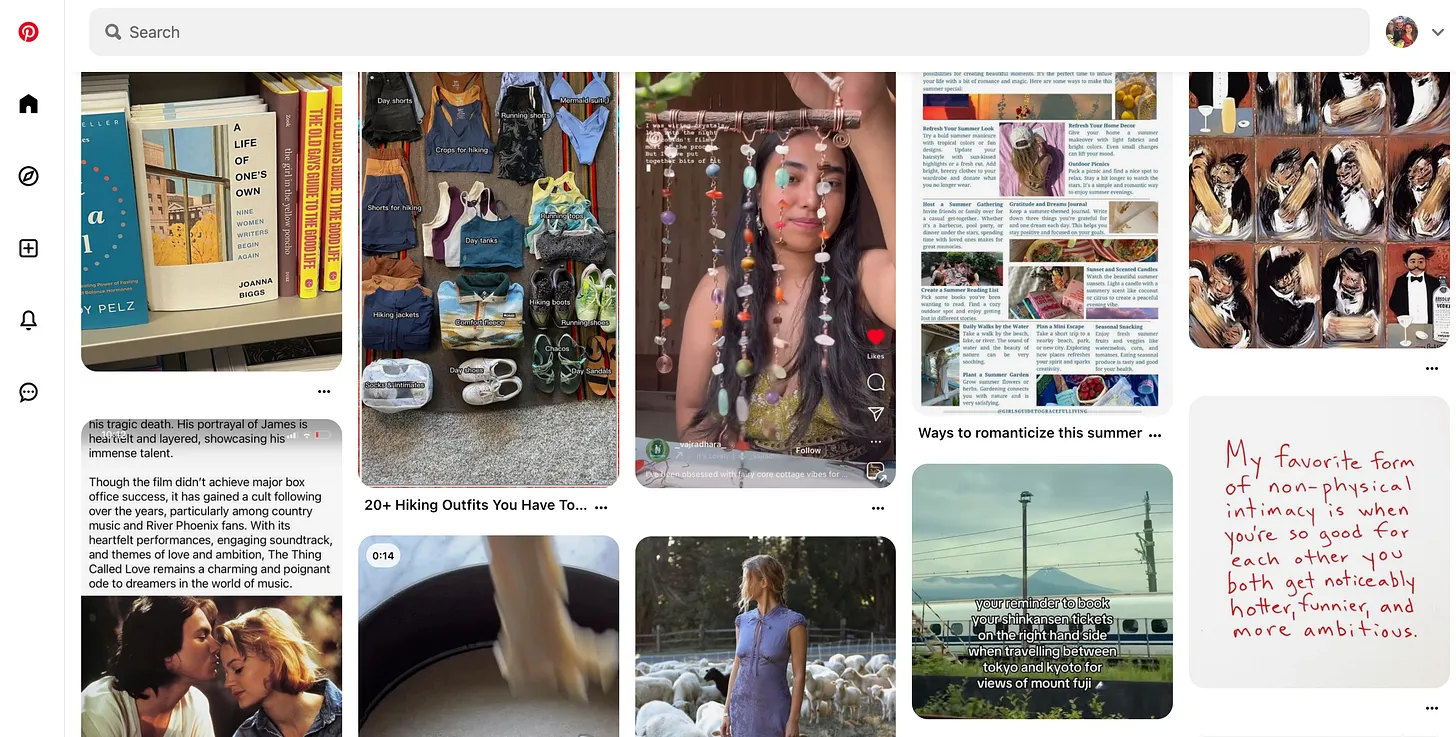
As an avid pinterester, I derive immense inspiration and wisdom from my Pinterest feed, and occasionally, I come across content that feels like nuggets of gold. (See below a snapshot of my typical pinterest feed.)
The Nine Delights is, to me, a way to enjoy and find meaning in each day — a reminder of how many different ways there are to have a good day, to find pleasure or meaning in a moment. Sure, peak experiences are magnificent and often fill us with a sense of awe that feels monumental and life-altering. But life is made up of minutes, hours, and days — of the ordinary. And to me, it’s just as important to curate a daily life — an Alltag (literally: all day), as we say in German — as it is to seek out those peak experiences that make existence feel iridescent.
The Nine Delights image as a life philosophy was one of those nuggets of gold.
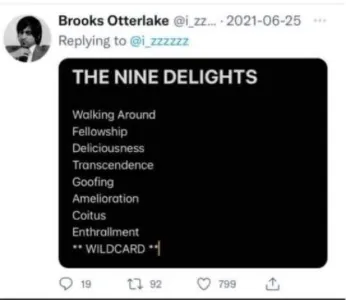
While I usually strive to find meta joy and meaning in life, this deceptively mundane approach stopped me in my tracks with its unassuming magnitude. The longer I sat with it the profounder it became. These nine, technically eight as the final one is a wildcard, acts or experiences all serve to enjoy and enrich ones’ life every day, and through their continuity, life as a whole. Note, it is not a checklist whereby you achieve a good day by doing all of the below. It is rather a way to sensitise yourself to the types of activities/ experiences that can make up a good day, and to try to incorporate them more consciously. And while these nine work well for me, different ones might work for you. Taking a deeper look at these nine activities / sensibilities shows that they’re also directly linked to many of the things both science and general wisdom tell us are key to a good life.
Walking around or wandering, is known to soothe, ground, and create space for curiosity and lightness. Wandering is a bit more than just walking, definable as an especially aimless or curious walking. The gentle engagement our brains experience when we move through mildly stimulating environments, called “soft fascination” by psychologists, lowers stress hormones, soothes a busy mind, and invites in lightness and wonder. Wandering lets thoughts flow without pressure, making space for clarity, imagination, and presence. It can also, almost miraculously to me, make the most intense feelings seem less overwhelming, or make them go away entirely. I have walked myself out of a funk more times than I can count, and will probably do so many more times. As the philosopher Kierkegaard put it: “Above all, do not lose your desire to walk: every day I walk myself into a state of well-being and walk away from every illness. I have walked myself into my best thoughts.”
Fellowship can be translated to connection and companionship, and not necessarily of the human-to-human kind but also connection to animals or other life forms one might feel a sense of kinship with. Connection is a cornerstone of wellbeing— oxytocin levels rise with social bonding, and even small moments of connection (a shared joke, eye contact, a sense of being seen) have profound effects on mood and resilience. Fellowship softens loneliness and reminds us we belong, grounds and soothes us. For me, this can look like chatting to my flatmates as we cook dinner together, asking people I take along in my car sharing how their day (or life) is, or calling friends while I walk home. When asked if friendship was half the spiritual life, the Buddha corrected his disciple: it’s the whole thing. Companionship isn’t a distraction — it’s the path.
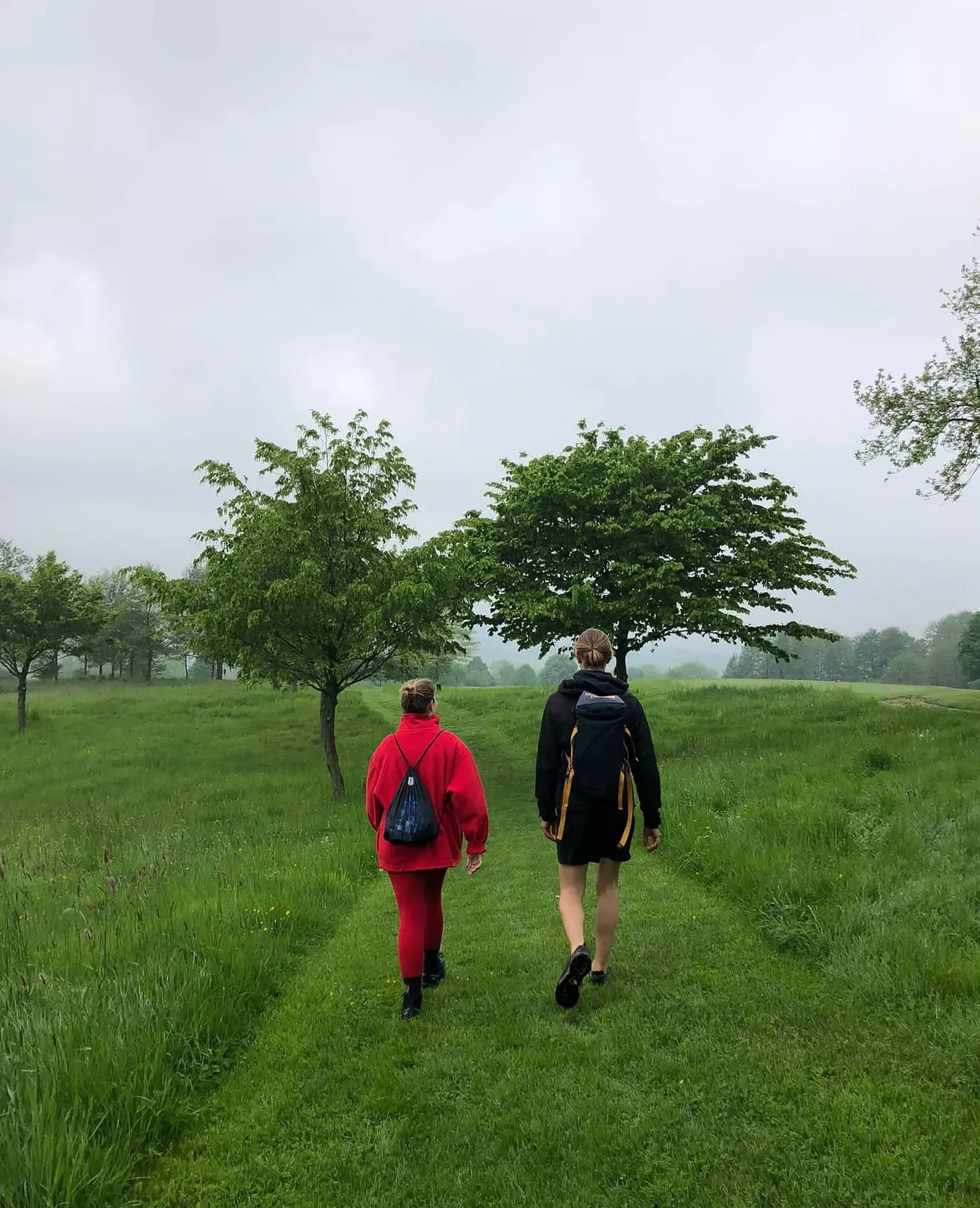
A friend and I wandering in companionship a few years ago, I’m the red blob.
Deliciousness loosely refers to deriving pleasure from food or drink, or more broadly, anything that we enjoy through our senses. Pleasure in food and drink, in scent and texture, roots us in the sensory now. Mindful eating and the enjoyment of taste stimulate the parasympathetic nervous system — the one responsible for rest, digestion, and repair. And beyond the biological: allowing ourselves to truly enjoy something reminds us that we are alive, and that life can be good. This, for me, often looks like bringing a treat with me (I have a sweet tooth), or cooking / picking up a meal I enjoy. The whole experience includes the preparation, the anticipation, the act of eating and enjoying it, and the quiet satisfaction afterwards. A mundane task of survival becomes a miniature ritual of pleasure and presence. Deliciousness, or enjoyment, also shows up in the moments when I stop to smell blooming trees and flowers, or pause for a sunset that delights me. It connects me to my body, and to what I can perceive and savour simply by being rooted and awake in it. In a world that often urges us to be efficient, productive, and fast, choosing to enjoy something — truly enjoy it — is a quiet, radical act. As said by Alain de Botton: “There is no need to be constantly purposeful. The pleasure of the senses is a purpose in itself.”
Transcendence takes us beyond ourselves — through art, nature, spiritual practice, or simply being moved. It suspends our individual thinking mind for a period, and creates access to something bigger, something shared across language, time, even species distinction. Research links awe and transcendence to improved sociality, humility, increased life satisfaction, and a sense of meaning. It doesn’t need to be a grand epiphany. It might be a single chord in a song that quiets the inner noise — a brief moment of stillness that feels eternal. For me, music is a powerful source of transcendence. Sometimes it’s listening closely to a song that touches something deep and ineffable (don’t we all have one of those songs?). Sometimes it’s singing in a Taizé prayer, or being at a concert, letting the texture of the music and the vibration of the singer’s voice wash over and through me. Transcendence can also come through visual beauty — in a painting, a sweeping landscape, or a beloved face. It may arrive through prayer, meditation, or even unexpected presence. Whatever the doorway, find something that both roots you in your body and extends you beyond it. Something that reminds you: you are part of a much vaster whole.

A common depiction of transcendence is the image of the spirit leaving the body, like above
Goofing, on the other hand, pulls you back down into yourself and reminds us that we’re human — gloriously imperfect and deserving of joy. Goofing — spontaneous silliness, being ridiculous, playing games — relaxes the nervous system, boosts immune function, strengthens bonds, and improves mood. It is disarming, humanising, and often exactly what a weary mind needs. Though often exclusively associated with children, it is one of the most basic pleasures in all animals, a behaviour which is incredibly valuable to people of all ages. Play rouses excitement, releases endorphins, and builds trust. I’m trying to cultivate more play in my life: embracing silliness with friends — tussling, joking, plotting pranks. But also solo play — balancing things on my head just to see if I can, walking only on the cracks in the pavement, or crafting absurdly long alliterative sentences purely for the joy of it. It’s a practice of finding the balance between gravitas and levity — between being a wise sage and a playful child. Maybe the real wisdom is knowing when to be both. In the spirit of fun and goofing, here a fitting quote from Kurt Vonnegut: “We are here on Earth to fart around. Don’t let anybody tell you any different.”
Amelioration, (or improvement), can be of the self, of a craft, of a system. The drive to improve — ourselves, our surroundings, our tools or ideas — gives a sense of progress, purpose, and agency. This doesn’t have to be productivity in the capitalist sense; it might be learning a chord, mending a sock, clearing clutter, or changing a habit. Small acts of betterment restore a sense of control and care. They remind us that we can make a difference, even if only in our immediate world. It could be as simple as picking up litter, perfecting a recipe, or rewriting one sentence — all of which live in my own toolbox. This is not meant forcefully. You do not need to be “1% better every day.” Instead: learn. do. redo. Improvement, at its best, is an act of devotion — not pressure. I have a whole range of areas of my life and myself that I want to improve, and though I haven’t neatly organised them into a list (yet), I am always somewhat aware of them. Whenever the opportunity presents itself, I try to gently encourage myself to just do it. The “it” here can be doing the dishes right away, to be more patient with family, or to cycle instead of taking the tram. It is about doing an action. Being perfect in thought is great but ultimately unhelpful if it is not also accompanied by the according action.
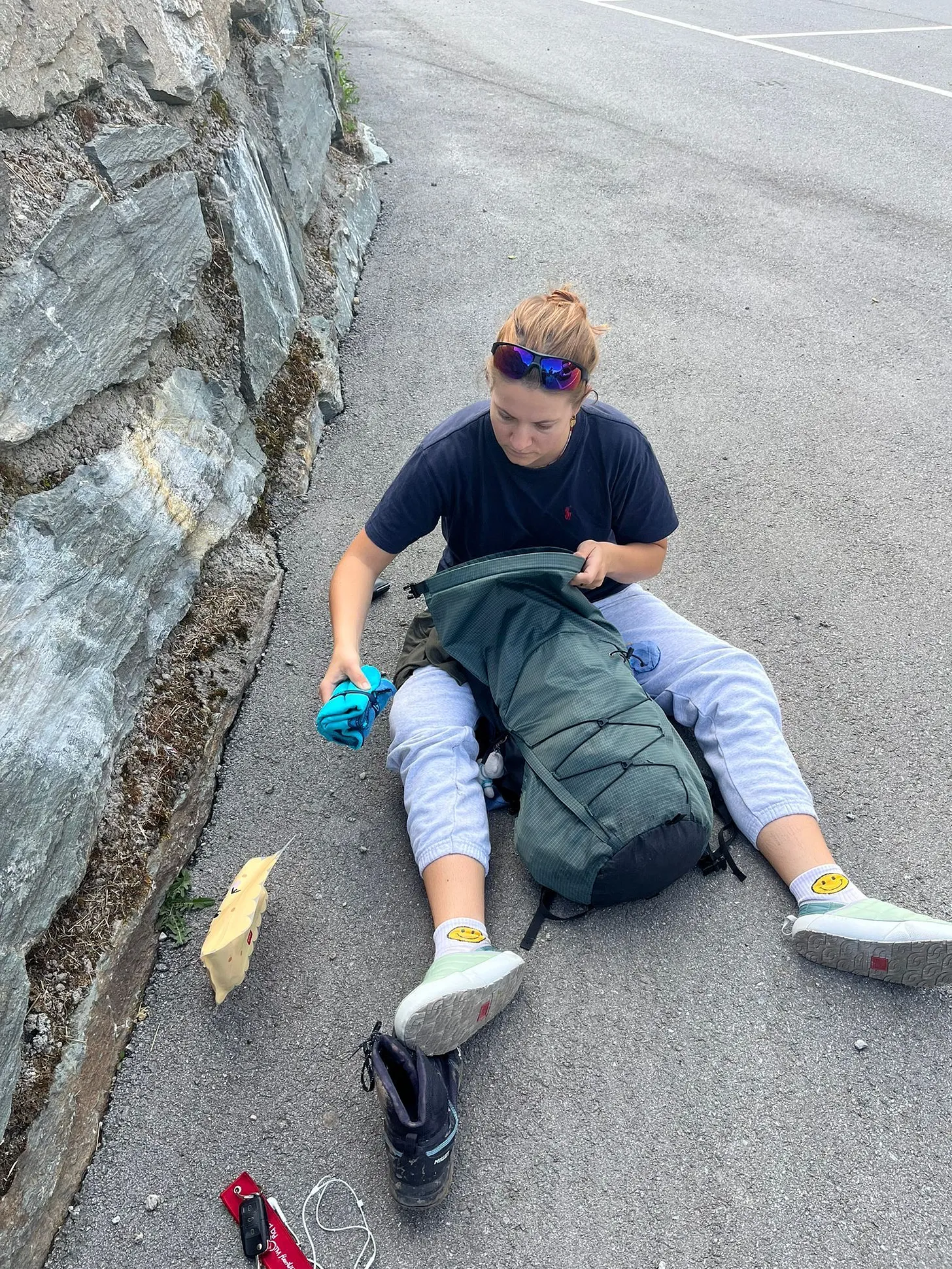
It might seem out of place, but this is me deciding that I could back my hiking backpack more usefully, and thereby deciding to figure out and improve my packing system. Even a small improvement counts.
Coitus, or sex, — whether shared with another or experienced solo — offers connection, intimacy, and embodiment. At its best, it dissolves separateness and creates closeness, presence, and delight. Physical intimacy* releases oxytocin and dopamine, lowers stress, and deepens relationships. It can be playful, sacred, therapeutic, or simply pleasurable — but in all cases, it reconnects us to the body and to each other in vital, primal ways. (Especially those of us who exist primarily in our heads as opposed to the rest of our bodies.) Moreover, sexual activity has been linked to various health benefits, including improved immune function, better sleep, and reduced anxiety. These effects underscore the role of sex as not only a source of pleasure but also a contributor to holistic health. In essence, eroticism and coitus are more than physical acts; they’re multifaceted experiences that intertwine the emotional, physiological, and existential aspects of our being. It reconnects us to ourselves and to others, reminding us of our capacity for joy, pleasure, vulnerability, and profound connection. As the brilliant psychotherapist and author Esther Perel puts it: “Eroticism is not about sex but about the poetics of sex — it’s about meaning, exploration, imagination, and the ability to stay connected to oneself while being with another.”
Enthralment is to be fully absorbed in something — a book, a task, a conversation, a moment of creative flow, and to be momentarily relieved of the burden of self-consciousness. Enthralment offers what psychologist Mihaly Csikszentmihalyi called flow: that sweet spot where challenge and skill meet, and time disappears. It feels good because it’s energising, meaningful, and often joyfully productive without the pressure of “usefulness.” Neuroscience shows that deep focus activates the brain’s reward system, releasing dopamine that fuels motivation and pleasure. One of my newest lists (I am a list-maker by vocation) is where I’m figuring out what activities enthral me — those that make me lose track of time. Good conversation is one of them; reading and writing too; swimming, hiking, or cycling with others or while listening to music; or being deeply focused on mending clothes, cooking or baking, or collaging.

Here I was spontaneously stopping on the side of the road and stepping to the edge of the cliff to feel closer to the view that moved me in that moment.
The Wildcard is the delight you didn’t predict. It might be a niche passion, a weird little ritual, or a moment that doesn’t fit any category but still fills you up. Wildcards remind us that aliveness isn’t formulaic — and that meaning often comes from the unexpected. It’s a space for whatever your version of delight looks like today — even if no one else would think to call it that.
Recently, I lost my house key. A big fat Nein to delight. After being let in by my flatmate, I grumbled around the apartment, then spent the next day wondering — obsessively — where the keys could have gone. I hadn’t done anything differently! I was sure of it. That evening, I came home disgruntled. My flatmate wasn’t answering his phone. I was in the building but locked out of the flat. Cue me: slumped on the doorstep, watching YouTube Shorts (if the day was going to fall apart, might as well get brain rot too). [Bear with me, I know this doesn’t sound like delight.]
Then, my neighbour came out for her regular smoke break.
“Forgot your keys?”
“Worse. Lost them. Yesterday.”
“You know, there’s a pair of keys hanging from the pinboard downstairs…”
“Wait — do they have a red keychain by any chance?”
“Yep.”
As we walked down together, I was giddy with hope and too scared to let it fully bloom. And there they were — my keys, dangling casually from the board like they hadn’t caused me hours of stress sweats.
Entirely unexpected, completely out of my control, and utterly delightful. A wildcard.
While having a strong sense of purpose matters, it means little if you don’t tend your own garden enough to let it bloom. Without inner abundance, there’s little left to offer others. As many voices in more restorative spaces remind us: self-care is political — even radical. By consciously shaping a life that you enjoy (emphasis on joy), you generate an energy that ripples through your relationships, your work, and your world. Incorporating small elements of that joy every day might just help root you more deeply in your Alltag — your everyday life.
*This only refers to (mutually) consensual and actively desired physical intimacy.
]]>